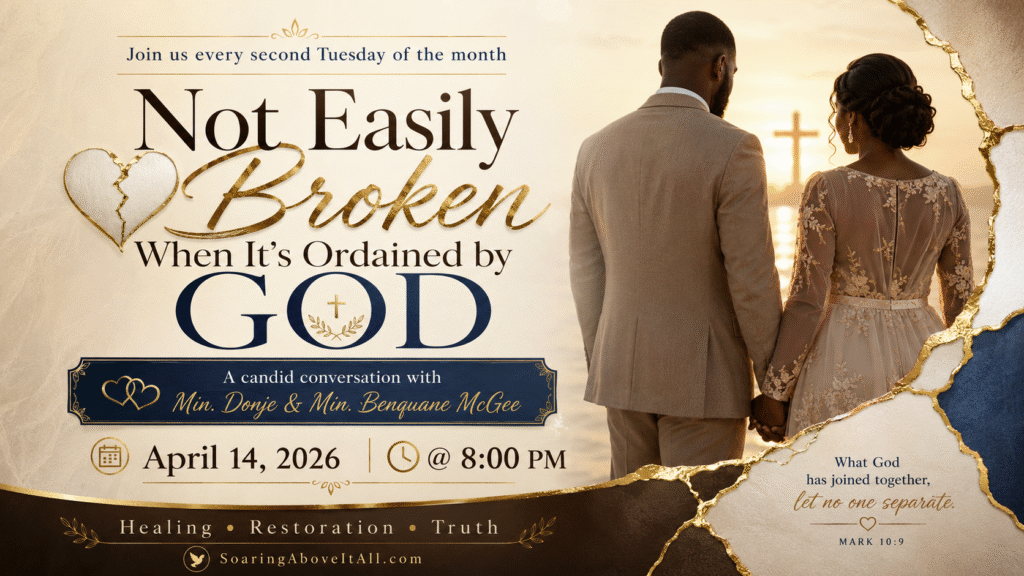
Join us every second Tuesday of the month as we create a safe space for honest conversations, healing, and transformation.
On April 14, 2026, at 8:00 PM, we had the honor and privilege of sitting down with Min. Donje and Min. Benquane McGee for a candid conversation titled, “Not Easily Broken When It’s Ordained by GOD.”
This conversation was not surface-level. It was not polished church talk. It was real. It was honest. It was layered with pain, grief, mistakes, accountability, healing, marriage, restoration, and the power of God to rebuild what life tried to break.
Their testimony reminded us that some stories do not look like restoration while they are happening. Sometimes it looks like rejection. Sometimes it looks like survival. Sometimes it looks like addiction, running, silence, anger, grief, infidelity, broken communication, and two people who love each other but do not yet know how to love each other well.
But when God is still in the story, broken does not have to mean finished.
Min. Donje shared pieces of her journey with deep honesty. She spoke about childhood wounds, feeling rejected, searching for love, and trying to survive without a firm foundation of identity. She talked about places in her life where pain led her into decisions and environments that could not heal her, only numb her for a moment. Her story showed how a person can know of God, but still be searching for who they are, where they belong, and why they are valuable.
Min. Benquane also opened up about his own wounds. He spoke about childhood trauma, father wounds, addiction, and the process of becoming the man God called him to be. One of the strongest parts of his testimony was the understanding that the little boy inside of him had to be healed so the grown man could live. That statement alone can help so many men and women understand that age does not automatically equal healing. Sometimes we grow up physically while still reacting from places that were wounded years ago.
Together, they shared how marriage exposed what had not been healed. They faced grief, loss, pressure, communication issues, blame, and moments where they were both hurting but did not know how to properly reach for help. They talked about losing a child, losing stability, and trying to carry weight that was too heavy for a young marriage to carry without healing, counsel, and truth.
One major truth from their story is this: love alone is not enough if both people are still bleeding from places they refuse to face.
You can love someone and still hurt them.
You can be married and still be emotionally disconnected.
You can provide and still not know how to be present.
You can stay in the same house and still not deal with the root.
That is what made this conversation powerful. They did not just talk about what happened. They talked about what had to be healed.
There came a point where they had to do the hard work separately. Therapy, prayer, accountability, spiritual leadership, self-examination, and quiet healing all played a part. Their restoration was not rushed. It was not built on pretending nothing happened. It came through revisiting dark places, having difficult conversations, and allowing God to work on both hearts.
Their story also reminded us that reconciliation is not just two people coming back together. True reconciliation requires truth. It requires maturity. It requires changed behavior. It requires both people to be willing to say, “I am not the same person I was before, and I cannot bring the old version of me into this new place.”
One of the most beautiful parts of their testimony was when they talked about rebuilding friendship while co-parenting. Healing made room for friendship. Friendship made room for honest conversation. Honest conversation made room for God to reveal that the story was not over.
Now they call this new chapter McGee 2.0 — not because everything is perfect, but because it is different. It is healthier. It is more honest. It is covered with more wisdom. They are learning communication, love language, emotional presence, and what it means to choose each other from a healed place instead of a wounded one.
This is not a message telling anyone to return to a harmful place without wisdom, safety, repentance, accountability, and healing. Restoration without healing is not restoration; it is just another cycle. But when God truly does the work in both people, when both people surrender, grow, and mature, He can rebuild something stronger than what was broken.
Their testimony reminds us that what is ordained by God will still require obedience, healing, humility, and truth. Being ordained does not mean there will be no warfare. It means the warfare does not get the final say.
Journal Prompts to Help You Process the Conversation
- What part of this testimony challenged me the most?
- Are there any childhood wounds still influencing how I love, communicate, or respond to pain?
- Have I ever mistaken survival for healing? What did that look like in my life?
- What roots have I been avoiding because it feels easier to manage the symptoms?
- Do I know how to receive love in a healthy way, or do I push it away because of past hurt?
- Download FREE resources to start your healing journey!
Scripture and Truth Points from Their Story
Ecclesiastes 4:12 reminds us that a threefold cord is not quickly broken. A relationship covered by God, truth, and healing has a different kind of strength.
Psalm 147:3 says God heals the brokenhearted and binds up their wounds. Healing is not just about moving on. It is about allowing God to touch the place that still hurts.
Romans 12:2 teaches us to be transformed by the renewing of our mind. Many battles in relationships are not just about what happened today, but about old thoughts, old wounds, and old patterns that need to be renewed.
Genesis 50:20 reminds us that what the enemy meant for evil, God can turn for good. Their story is proof that God can use broken places as a testimony of His power.
Isaiah 61:3 speaks of beauty for ashes. God does not ignore the ashes. He takes what burned, what broke, and what looked ruined, and He brings beauty out of it.
Takeaways for Healing
Healing requires honesty. You cannot heal what you keep covering.
Childhood trauma does not stay in childhood. If it is not healed, it can show up in marriage, parenting, communication, anger, fear, and emotional distance.
Love needs maturity. Love needs communication. Love needs accountability. Love needs God.
Grief can change a relationship if both people do not know how to process it together.
Silence may protect the image, but it can destroy intimacy.
Therapy, prayer, wise counsel, and spiritual covering are not signs of weakness. They are tools for healing.
Restoration is possible, but it must be built on truth, not pretending.
God can restore, but both people still have to do the work.
Watch the Replay
If this conversation pulled on your heart, I encourage you to go back and watch the full replay.
Watch Replay:
Join the Conversation
After you watch, come back to the blog and share your thoughts in the comments.
What part of their testimony spoke to you?
What truth did you hear that challenged you?
What area of your life do you believe God is healing right now?
Your story may be different, but healing is still possible. Restoration is still possible. Freedom is still possible.
Because when God is not finished, broken does not get the final word.
Leave a Reply